The Euro NCAP star rating helps consumers easily compare how safe different cars are. Every new car tested by Euro NCAP is given a score from zero to five stars, based on how well it protects occupants, how effectively it helps prevent accidents, and how it facilitates safe and secure rescue after an incident. A zero-star rating indicates the car meets legal standards but lacks critical modern safety features.

Overall excellent performance in crash protection and well equipped with state-of-the-art crash avoidance technology.

Overall good performance in crash protection and prevention, but does not reach the highest standards in all key assessment areas.

A vehicle that provides an average level of safety performance, offering a medium standard in safety.

Nominal crash protection but below-average performance in one or more of the key assessment areas.

Marginal crash protection and minimal crash avoidance technology beyond the legal requirements.

Meeting type-approval standards so can legally be sold but lacking critical modern safety technology.
To determine a car’s rating, Euro NCAP conducts a series of safety and functional tests. The tests are designed to reflect real-life accidents, helping drivers, families, and businesses choose the safest vehicle for their needs. A car's score is determined not just by how well it performs before, during, and after a crash, but also on the standard safety features it includes. This means that a five-star model offers superior overall safety in all markets From 2026, assessments will be structured around four key pillars:
Safe Driving – Considers the vehicle technologies and features that assist in providing a safer driving experience for the driver and vehicle occupants.
Crash Avoidance – Assesses the crash avoidance systems that help prevent or mitigate critical incidents through warnings or autonomous intervention.
Crash Protection – Evaluates the performance of traditional crash protection elements, including vehicle structure, seatbelts, airbags, and head restraints to mitigate injuries to vehicle occupants, pedestrians, and cyclists.
Post-Crash Safety – Addresses the ‘golden hour’ of emergency response through post-crash rescue information and assistance systems.

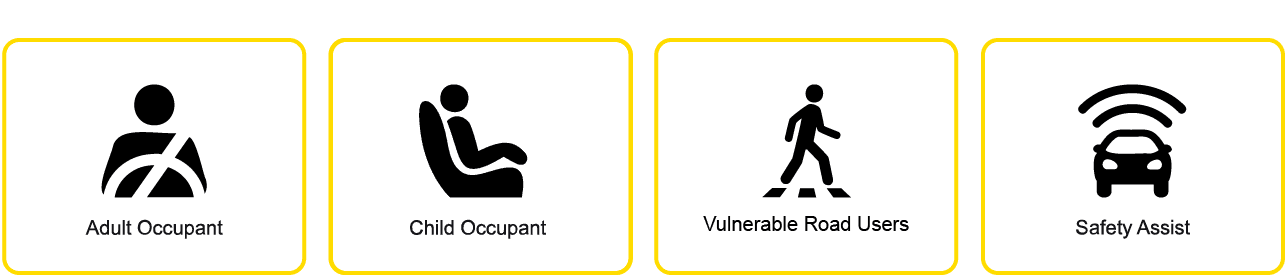
Up to 2025, a range of tests and assessments was conducted for each area of safety, with vehicles required to meet minimum score thresholds for each star rating level. Importantly, the overall star rating of a vehicle was limited by its lowest performing pillar of assessment to encourage vehicle manufacturers to offer balanced safety performance across all areas. The areas of assessment were the following:
Find the safest cars for your needs and budget, using Euro NCAP's simple search tool to compare the safety of both new and old models.

Since 2016, some cars have been given two safety ratings: one based on the standard safety equipment fitted to every version sold across Europe, and another, higher rating if an optional safety pack is added.
To be eligible for an optional star rating, the manufacturer must offer the safety pack as a standalone option and meet minimum fitment rates. Over time, several safety features that were initially available only in these packs have become standard on all new cars.



Euro NCAP regularly updates its testing protocols to reflect advances in vehicle safety technology. As a result, a car’s safety rating is valid for up to six years from the date it is awarded. After this period, the rating expires – not because the vehicle has changed, but because safety standards have evolved. If a vehicle receives a facelift or significant update during this six-year period, Euro NCAP reviews the changes to determine whether the existing rating remains valid.
For this reason, the latest star rating is always the most relevant. Comparing ratings from different years is only meaningful if the changes to the rating system were minor.
Innovation doesn’t stop, and as such, cars are getting safer and smarter. In recognising this, Euro NCAP's test and rating process has also evolved. The criteria we use to rate vehicles have increased incrementally over the past three decades, and today, these criteria are updated every three years.