
Electronic Stability Control
How does Electronic Stability Control operate?
How effective is ESC?
How do I know my car has ESC?
Do all 5-star cars have ESC?
Should I always switch on ESC?
How does Electronic Stability Control operate?
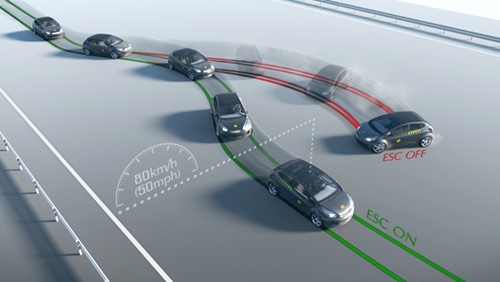
When ESC detects a loss of steering control, ESC automatically applies the brakes to help manoeuvre the vehicle where the driver intends to go. Braking is automatically applied to individual wheels depending on the situation. ESC normally consists of the electronic systems of traction control and ABS using several sensors such as steering wheel angle sensor, yaw rate sensor, lateral acceleration sensor and wheel speed sensor to monitor the vehicle’s direction of travel and the driver’s intended course. ESC cannot be retrofitted and needs to be fitted before sale.
How effective is ESC?
ESC is a proven safety system. At least 40% of fatal road accidents are the result of skidding. International studies show that ESC reduces skidding accidents between 25% and 35% depending on road conditions.
How do I know my car has ESC?
Although Electronic Stability Control is officially abbreviated as ESC, the technology on your car can be referred to as ESP (Electronic Stability Programme), DSC (Dynamic Stability Control),VSA (Vehicle Stability Assist), VSC (Vehicle Stability Control) or other alternatives depending on the brand of car. Unfortunately, ESC is not always fitted as standard or available on all vehicles. Ask your dealer for more information about ESC and whether it is fitted on your car or available as an option upon purchase.
Do all 5-star cars have ESC?
For a car to be awarded 5 stars, ESC must be at least optionally available on all of the tested model variants on sale in the EU-27. Moreover, ESC must be present on 90% or more of all variants sold in the EU-27. Currently, Euro NCAP does not test or compare the performance of various ESC systems, but has compared the performance of cars with and without ESC.
Should I always switch on ESC?
It is safer that you never switch off ESC. ESC is always on when switching the ignition on. Some cars may allow the system to be switched off manually. Turning it off produces a warning light in the dashboard. It is advised to always drive with ESC switched on, except when activation would prevent the vehicle of pulling out of a slippery slope, ramp or other similar situations.