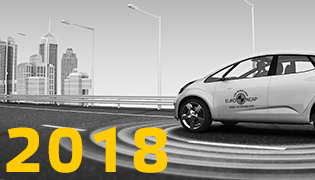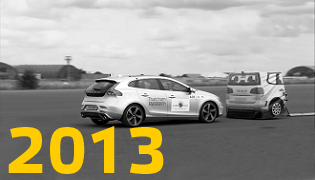
Since 2008, Euro NCAP has been promoting broad fitment of Electronic Stability Control - ESC - by all vehicle manufacturers.
Up to 2012 when ESC becomes mandatory for all new cars sold in the EU, each vehicle manufacturer can decide whether or not to make ESC available on a certain model (variant). Consequently, ESC fitment varies greatly between different European countries and between different vehicle categories. To drive greater levels of fitment, in 2009 Euro NCAP has begun awarding three Safety Assist points to a car if ESC is fitted as standard across the model range, or if it is an option on every variant and the manufacturer also expects to sell at least 95 percent of cars with the system as standard equipment. This fitment requirement is steadily increasing and by 2012 Euro NCAP will only reward equipment which is fitted as standard across the whole of the model range.
In addition, as of 2011, Euro NCAP performs the so called “sine-with dwell” test on all cars that meet the ESC fitment requirement in order to check its performance. The car is eligible for ESC points only when it passes the criteria in this test.
Car manufacturers and their suppliers perform many hundreds of tests when developing ESC systems for their vehicles. They try to ensure that the system will work in every possible circumstance: different speeds and road conditions, and different manoeuvres and driver response.
So far, analyses of real-life accident have demonstrated that cars equipped with ESC are involved in fewer accidents and less serious ones, than cars without. However, it has not yet been possible to differentiate between the safety offered by different types of ESC systems.
With the experience from the dynamic tests of 2011 and onwards, Euro NCAP and its members are continuing to work on possible refinements to the ESC test and assessment methods. Have a look at the ESC performance tests
How is ESC tested?
ESC systems are assessed by performing a series of tests in which steering and yaw behaviour can be simultaneously evaluated. These are called the “sine-with dwell” tests and are based on an actual double lane change manoeuvre. They are carried out at 80 km/h with sudden steering wheel rotations up to 270 degrees.
A car will pass the “sine with dwell” test when it has met three criteria. The first criteria is the lateral, or sideways displacement, which must be more than 1.83m. In other words, the sideways displacement must be sufficient to actually change lane as intended to avoid the object that was in your lane.
In order to make the double lane change, the car must react to the steering input which is ensured by the ESC system and verified with the lateral displacement criteria. However, after the steering maneuver the car must stay stable. This is verified with two other criteria that determine the yaw-rate after the steering maneuver is completed. They may only be a small percentage of the maximum yaw-rate during the steering maneuver to ensure that the car will follow a straight path after the steering input.
More information on ESC can be found in the FAQ section.