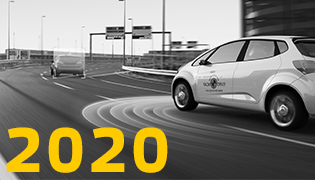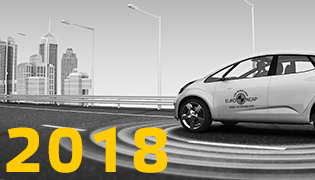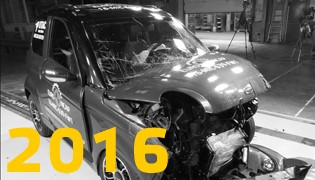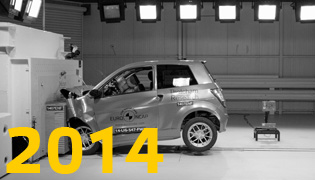
Test procedures

Meet the drivers

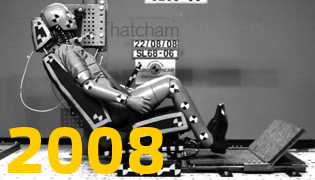
Hybrid III and EuroSID II have experienced dozens of crashes first-hand. Their role is vital: the accident simulations rely on having a driver and passenger aboard to provide a full picture of likely injuries in a crash, although the pedestrian safety tests use simulated limbs to chart what happens in a collision.


Hybrid III and EuroSID II are no ordinary driver and passenger: these are steel-skeletoned, rubber-skinned dummies packed with sensing equipment. To build, they each cost in excess of £100,000.


What Dummies Know

Dummies provide vital clues to what happens in a crash. Our limb- by-limb anatomy guide explains how data is sourced.

Head
The head is made of aluminium and covered in rubber 'flesh'. Inside, three accelerometers are set at right angles, each providing data on the forces and accelerations to which the brain would be subjected in a crash.

Neck
Features measuring devices to detect the bending, shearing and tension forces on the neck as the head is thrown forwards and backwards during the impact.
 
Arms
Neither arm carries any instrumentation. In a crash test, the arms flail around in an uncontrolled way, and although serious injuries are uncommon, it is difficult to provide worthwhile protection against them.

Chest(front impact)
Hybrid Ill's steel ribs are fitted with equipment that records deflection of the rib cage in the frontal impact. Injuries result if forces exerted on the chest, such as from the seat belt are too great.

Chest (side impact)
The side-impact dummy, EuroSID II, has a different chest from the others and three ribs are instrumented to record compression of the chest and the velocity of this compression.
 
Abdomen
EuroSID II is equipped with sensors to record forces likely to cause abdominal injury.

Pelvis
EuroSID II has instruments fitted in its pelvic girdle. They record lateral forces that may result in fractures or hip-joint dislocation.

Upper Leg
In Hybric III, this area is made up of the pelvis, femur (thigh) and knee. Load cells in the femur provide data in frontal impacts on likely injury to all sections, including the hip joint which can suffer fractures and dislocations. A 'knee slider' is used to measure forces transmitted through the dummy's knees, particularly if they strike the lower facia.

Lower Leg
Instruments fitted inside the dummies' legs measure bending, shear, compression and tension, allowing injury risks to the tibia (shin-bone) and fibula (connecting knee to ankle) to be assessed.

Feet and Ankles
Assessment of injury risk in the frontal impact is made by afterwards measuring distortion and rearward movement of the driver's footwell area.